Histological examinations showed intense involvement of the superficial layers of the epidermis and qPCR analyses yielded infection loads greater than 100 000 genomic equivalents of zoospores. These results suggest that this introduced species could behave as a Bd ‘supershedder’, and recommend to control its expansion due to its important role in the dynamic of chytridiomycosis. Leer más.





emarkable range increases occur for the subspecies V. monticola atlanticaand V. monti-cola monticola, the latter confirmed by genetic assessment, as well as for V. monticola saintgironsi with a new record in Jbel Bou Naceur. We note the occurrence of habitat degradation across the species range, likely promoted by anthropogenic factors as deforestation, aridification and ove rgrazing. Leer más.

Studies of the effects of insularity on animal signals are scarce, particularly in lizards. Here, we use Lilford’s wall lizard from Dragonera (Podarcis lilfordi gigliolii) to ask how island conditions have affected its repertoire of social signals, focusing on two visual signals shared by many Podarcis species: ultraviolet (UV)–blue-reflecting ventrolateral colour patches and visual displays. Leer más.

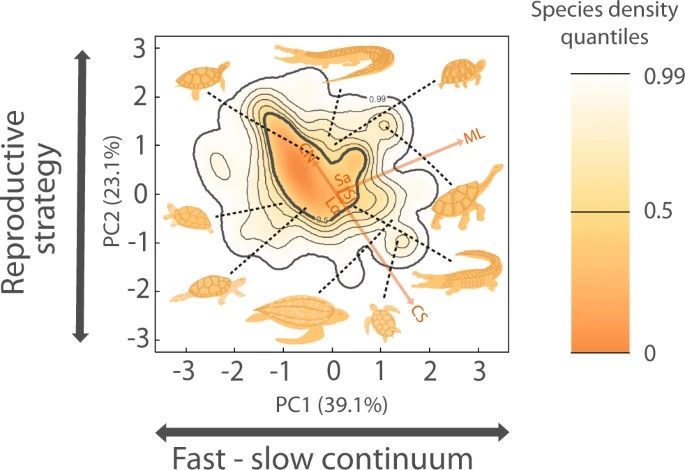
Our findings highlight the importance of conservation programmes focused on preserving the functional diversity of life history strategies jointly with the phylogenetic representativity of these highly threatened groups. Leer más.
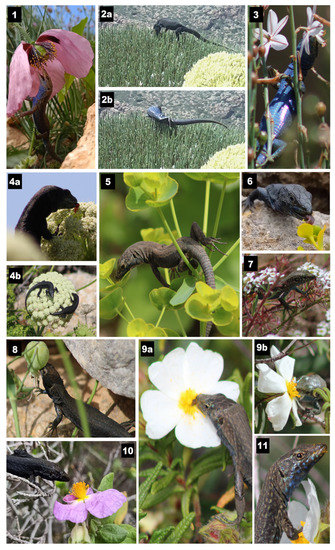
The role of lizards as potential pollinators is increasingly recognized, especially on islands. However, there are very few studies at the community level that have also addressed intraspecific variations related to the consumption of floral resources. We pursued this objective on the island of Cabrera Gran (Balearic Islands) where there are the Balearic wall lizards (Podarcis lilfordi) and two geckos (Tarentola mauritanica and Hemidactylus turcicus). Balearic lizards have proven to be potential community-level pollinators by interacting with many different plant species to varying degrees. Although in some plant species lizards damaged reproductive structures by feeding directly on them, legitimate visits were significantly more frequent. Intraspecific differences were found in these wall lizards and even indications of gecko–flower interactions. These findings expand our knowledge not only on the magnitude of lizard–plant community interactions but also in their complexity. Leer más.